The first Parergon builds exposed a pattern we had seen in every previous AI-assisted project. Claude would write fluent Swift, but “fluent” is not the same as “correct for this platform.” It would reach for a generic API when a platform-native one existed. It would use a SwiftUI idiom that was already deprecated. It would invent framework names that sounded right but did not exist.
The code looked plausible. It was not.
Why a “smarter AI” was not the fix
The problem was never that the model lacked capability. It was that the model lacked context you cannot get from training data alone: the specific framework surfaces Apple ships this quarter, the design rationale behind the latest Swift Evolution proposal, the idiom Apple engineers themselves would choose in a given situation.
Training data is a snapshot. Apple ships a new SDK twice a year. Swift Evolution closes proposals weekly. A model answering from training alone is always, at best, a few months behind the thing you are actually building against.
The fix was not a better model. The fix was giving the model a way to look things up, precisely and on demand.
The Swift MCP Server, in one paragraph
The Swift MCP Server is a local service that exposes Apple’s documentation ecosystem to Claude Code through the Model Context Protocol. It indexes over 1,000 entries across three primary sources (Apple API reference, Swift Evolution proposals, and the Swift book), and it lets Claude query that knowledge with framework filters, proposal IDs, and idiom checks. When Claude writes Swift for Parergon now, it is writing against a live view of the platform, not a months-old memory of one.
This is the quiet shift that made AI-native macOS development feel native. It is a pattern worth copying on any platform with deep, fast-moving documentation.
What it indexes
| Source | Indexed documents | How it is kept current |
|---|---|---|
| Apple API reference | 300+ | Auto-populated from developer.apple.com |
| Swift Evolution proposals | 400+ | Mirrored directly from the Swift Evolution GitHub repo |
| The Swift Programming Language book | 327 chapters and examples | Fully indexed with code examples |
Seventeen specialist tools sit on top of that index, so Claude can ask targeted questions rather than scraping pages.
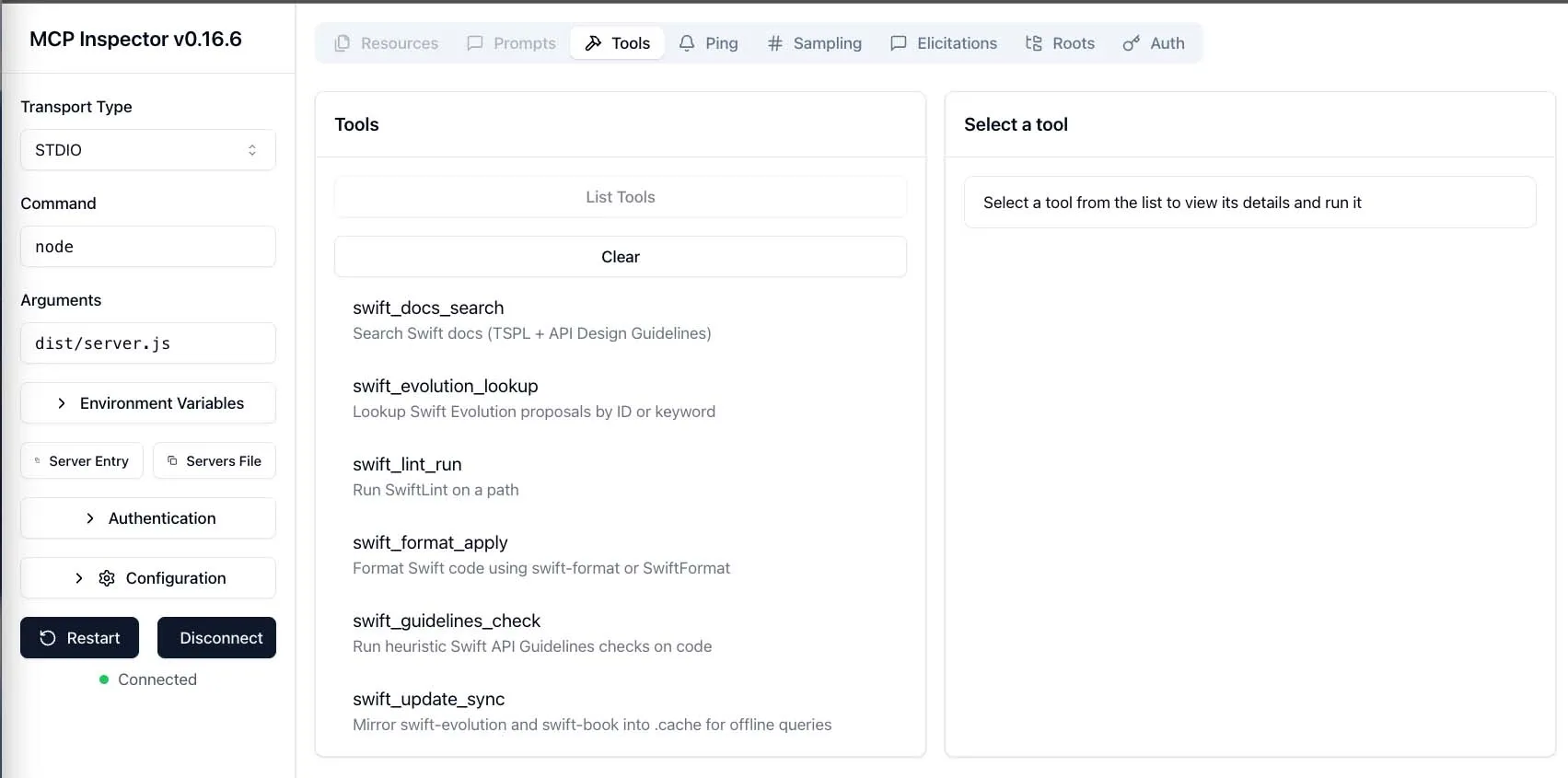 The MCP Inspector interface displaying the full toolkit available through the Swift MCP Server.
The three queries that changed our workflow
apple_docs_search resolves specific framework behavior. Instead of asking Claude “how does NSWindow handle level changes”, it now asks Apple, then writes the code. The difference shows up in every review.
swift_evolution_lookup surfaces the rationale behind a language feature. Reading proposal SE-NNNN before using a new syntax changes how the feature gets applied. The code stops looking like a translation from another language and starts looking like idiomatic Swift.
swift_guidelines_check checks our code against Apple’s API Design Guidelines. It catches naming, capitalization, and convention drift before it reaches review. Small thing, compounding effect.
Patterns and recipes
Frameworks change. Patterns are forever.
On top of the documentation index, the server ships a library of YAML-defined recipes for frequent macOS tasks. A video export recipe, for example, captures the full AVMutableComposition plus AVAssetExportSession flow, including the small correctness details (frame timing, presentation intent, correct export preset) that are easy to get wrong.
When Claude asks “how do I export a video with an overlay,” it does not get a generic answer. It gets our vetted workflow.
What changed in practice
The Swift MCP Server is one part of Zalo Design Studio’s AI-native engineering approach. Its effect is easy to describe:
- Fewer “looks right but is wrong” moments in review
- Code that Apple engineers would recognize as idiomatic
- Less time spent correcting deprecated API use
- Faster onboarding onto any macOS framework we have not touched before
We do not measure AI-native development in lines of code per hour. We measure it in how often the code we commit is the code we keep. This pattern moves that number up.
Frequently asked
Why not just use better prompting?
Prompting is how you ask a better question in one turn. It does not fix the underlying gap. If the model has learned NSWindow behavior from docs that are eighteen months old, a clever prompt still gets you an answer grounded in stale material. Indexed documentation lets the model look up the current answer. That is a different kind of fix, and it compounds over every query.
Does the Swift MCP Server replace Apple’s documentation? No. It makes Apple’s documentation accessible to Claude on demand. You still read it too.
Is it specific to Parergon? No. Parergon is the first product we built with it, but any macOS project benefits. We use it when an Apple-platform project needs current, platform-specific documentation.
Can teams outside Zalo Design Studio use it? Yes. It is open source and runs locally. See the GitHub link below.
Does it need internet access at runtime? Only for the initial population of the cache. After that, it serves queries from the local index.
For engineers: deployment
The Swift MCP Server runs as a local process. Quick start:
- Clone the repository. Download the source from GitHub and install dependencies with Node.js.
- Populate the cache. Run the update script to download the Swift book, mirror Swift Evolution proposals, and build local indexes.
- Wire it into your assistant. Add the server to your MCP settings so Claude Code (or any MCP-compatible assistant) can call it.
# Populate the local index with the frameworks critical to your project
node -e "import('./dist/tools/docs_populate.js').then(m=>m.docsPopulate({
  frameworks: ['SwiftUI', 'AppKit', 'Photos', 'Foundation'],
  maxPerFramework: 100
}))"
Download the Swift MCP Server on GitHub: github.com/gzaal/swift-mcp-server